
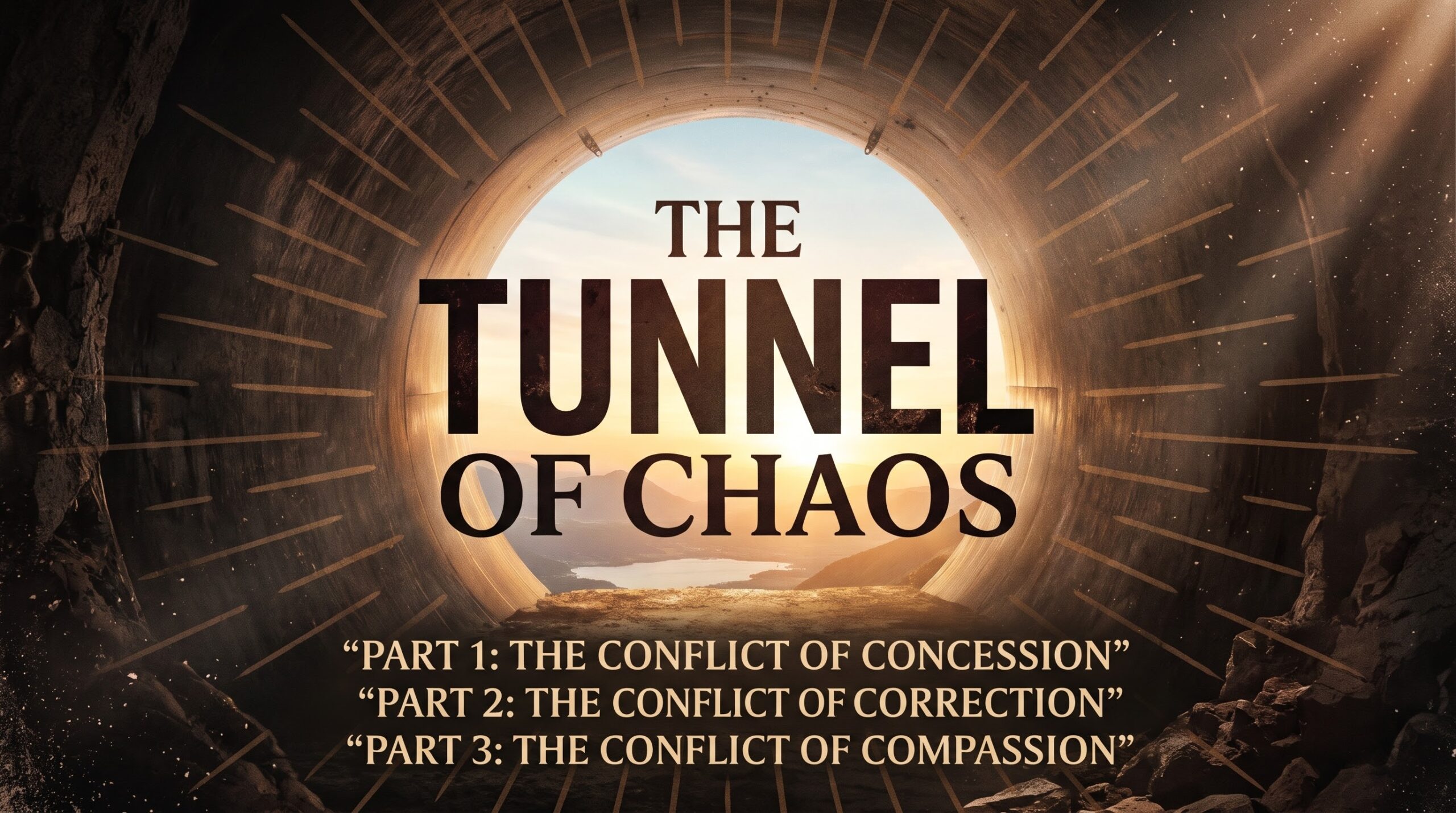
The Tunnel of Chaos — Part 1: The Conflict of Concession
Scripture: Acts 15:36–41 (NKJV)
Series: The Tunnel of Chaos — Part 1 of 3
Lily Baptist Church | Tarrant, Alabama
2026 Vision: All Things New
2 Corinthians 5:17 (NKJV)
“Therefore, if anyone is in Christ, he is a new creation; old things have passed away; behold, all things have become new.”
Our Declaration: “I’m becoming who God wants me to be.”
Throughout 2026, we are challenging ourselves to:
Believe — Trust God, trust the process, hear God clearly, and respond in worship.
Belong — Honor God, honor yourself, honor others, and create an environment for healing.
Become — Represent God everywhere, be the light in the room, and live as an ambassador for Christ.
These commitments challenge us to grow spiritually, but they also challenge us to improve the way we relate to one another.
If we are becoming who God wants us to be, we must learn how to navigate conflict in ways that honor God and protect our relationships.
Series Introduction: The Tunnel of Chaos
One of the most difficult things we will ever do is resolve conflict.
Conflict can happen anywhere.
In our marriages.
In our families.
Among friends.
At work.
And even in the church.
Sometimes conflict begins with something small. Two people disagree about a decision, a responsibility, or how something should be accomplished.
But when those differences are not addressed, they can grow into something much larger.
Before long, people who once worked together stop speaking to one another.
People who once loved one another become suspicious of each other’s motives.
People who once shared the same vision begin working against one another.
Welcome to the Tunnel of Chaos.
The Apostle Paul experienced many forms of conflict during his ministry. In Acts 15, we discover a disagreement between Paul and Barnabas, two faithful servants of God who had worked together to spread the gospel.
Their experience teaches us something important:
Sometimes the way through conflict requires us to make concessions.
The goal isn’t always to get everything we want.
Sometimes the goal is to preserve what matters most.
Main Scripture: Acts 15:36–41
Acts 15:36–41 (NKJV)
“Then after some days Paul said to Barnabas, ‘Let us now go back and visit our brethren in every city where we have preached the word of the Lord, and see how they are doing.’ Now Barnabas was determined to take with them John called Mark. But Paul insisted that they should not take with them the one who had departed from them in Pamphylia, and had not gone with them to the work. Then the contention became so sharp that they parted from one another. And so Barnabas took Mark and sailed to Cyprus; but Paul chose Silas and departed, being commended by the brethren to the grace of God. And he went through Syria and Cilicia, strengthening the churches.”
Paul and Barnabas had completed their first missionary journey and returned to Antioch.
After some time, Paul proposed that they return to the cities where they had preached the gospel to check on the believers and strengthen the churches.
It was a good idea.
It was a godly goal.
But there was a problem.
Barnabas wanted to take John Mark.
Paul did not.
That disagreement became the beginning of a serious conflict.
Let’s examine three lessons from their experience.
1. The Origin of Chaos
Acts 15:37–38 (NKJV)
“Now Barnabas was determined to take with them John called Mark. But Paul insisted that they should not take with them the one who had departed from them in Pamphylia, and had not gone with them to the work.”
The Problem Wasn’t the Mission
Paul and Barnabas agreed about their mission.
They wanted to revisit the churches they had established and strengthen the believers.
The disagreement concerned who should accompany them.
During their first missionary journey, John Mark had traveled with them as an assistant.
But something happened when the group reached Perga in Pamphylia.
Acts 13:13 (NKJV)
“Now when Paul and his party set sail from Paphos, they came to Perga in Pamphylia; and John, departing from them, returned to Jerusalem.”
John Mark left the missionary team and returned home.
Scripture does not explain exactly why he left.
Perhaps he was afraid.
Perhaps he was homesick.
Perhaps the demands of ministry were greater than he expected.
We don’t know.
What we do know is that his departure made an impression on Paul.
When Barnabas suggested bringing Mark on their next journey, Paul strongly objected.
Paul was committed to the ministry and wanted people around him who were equally committed.
Barnabas was determined to give Mark another opportunity.
Two faithful servants of God had different perspectives about the same person.
Neither was willing to abandon his position.
And that’s where the chaos began.
Different Perspectives Can Create Chaos
One of the most important lessons from this story is that conflict doesn’t always begin because someone is evil, dishonest, or intentionally hurtful.
Sometimes conflict begins because people see the same situation differently.
Paul may have been focused on commitment and reliability.
Barnabas was focused on including John Mark in the work.
Both were concerned about ministry.
But they disagreed about how to move forward.
We experience the same kinds of differences in our relationships.
We disagree about:
- Methods — How something should be done.
- Motives — Why someone is doing something.
- Feelings — How a situation affects us emotionally.
- Ideas — What we believe should happen.
- Reasoning — How we arrive at our conclusions.
- Opinions — What we believe is best.
Any one of these differences can create chaos when we allow disagreement to become division.
We’re All in the Same Boat
Think about a rowing team.
A successful rowing team must work together.
Everyone must row at the right time.
Everyone must move in the same direction.
Everyone must contribute their strength.
Everyone must understand the goal.
Now imagine one person decides to row at half strength.
The other rowers begin focusing on that person instead of the destination.
The team loses its rhythm.
Progress becomes difficult.
Now imagine removing that person from the boat.
The team may lose strength, move more slowly, or struggle to reach its goal.
The relationship matters because everyone in the boat contributes to the journey.
The sermon uses this rowing illustration to remind us that relationships require cooperation.
Marriage requires cooperation.
Friendship requires cooperation.
Ministry requires cooperation.
Church life requires cooperation.
When we stop working together, we risk losing sight of the very thing that brought us together.
You Cannot Resolve Conflict From Outside the Tunnel
When conflict appears, our natural response is often to avoid it.
We stop talking.
We withdraw.
We ignore phone calls.
We change our routines to avoid certain people.
We convince ourselves that the problem will eventually disappear.
But avoiding the conflict doesn’t necessarily resolve it.
You cannot resolve a conflict you refuse to address.
Sometimes we have to enter uncomfortable conversations because the relationship is worth protecting.
Questions for Reflection
- Think about a current disagreement in your life. Is the conflict really about the goal, or is it about the way someone wants to accomplish that goal?
- Have you ever assumed someone had bad intentions simply because they disagreed with you?
- Are you more like Paul, who was concerned about commitment and reliability, or Barnabas, who wanted to give Mark another opportunity? Why?
- What differences in methods, motives, feelings, ideas, reasoning, or opinions have created conflict in your relationships?
- Have you ever become so focused on another person’s shortcomings that you lost sight of your shared purpose?
- Is there a relationship in your family, workplace, or church where you have been standing outside the tunnel instead of addressing the conflict?
- What might happen if you approached that person with a desire to understand rather than a determination to win?
This Week’s Challenge: Identify the Real Conflict
Choose one unresolved disagreement in your life.
Before approaching the other person, write down your answers to three questions:
What is the real issue?
What do we disagree about?
What do we still have in common?
Then pray for the humility to see the situation from the other person’s perspective.
If it is appropriate and safe, begin a respectful conversation.
Don’t begin by defending your position.
Begin by seeking understanding.
Remember: You cannot find your way through the tunnel if you refuse to enter it.
2. The Growth of Chaos
Ephesians 4:26–27 (NKJV)
“‘Be angry, and do not sin’: do not let the sun go down on your wrath, nor give place to the devil.”
Paul teaches an important principle about conflict.
Unresolved anger can become an opportunity for greater damage.
Notice three instructions in this passage.
A. Be Angry, but Do Not Sin
Anger is an emotion.
We all experience it.
Sometimes anger is a reasonable response to something that has happened.
Someone may have disappointed us.
Someone may have broken our trust.
Someone may have treated us unfairly.
Someone may have made a decision that negatively affected our lives.
But Paul reminds us that feeling anger and acting sinfully are not the same thing.
You can acknowledge your feelings without allowing your feelings to control your behavior.
Anger becomes dangerous when it leads us to attack, insult, threaten, retaliate, or intentionally harm someone else.
We must learn to manage our emotions rather than allowing our emotions to manage us.
B. Don’t Let the Sun Go Down on Your Wrath
Paul warns us against allowing anger to remain unresolved and take root.
The longer we rehearse an offense, the more power we may give it over our thoughts.
We replay the conversation.
We imagine what we should have said.
We question the other person’s motives.
We begin interpreting everything they do through the lens of our hurt.
Eventually, the original problem becomes difficult to separate from all the new problems we have created.
Unresolved conflict has a way of spreading.
This instruction encourages us to deal promptly with anger rather than nurturing resentment. It does not mean every disagreement must be completely resolved before bedtime; some conversations require time, calm, and careful thought.
But we should not become comfortable holding on to bitterness.
C. Don’t Give Place to the Devil
When anger grows unchecked, it creates opportunities for temptation.
We may become tempted to retaliate.
We may become tempted to embarrass someone.
We may become tempted to spread rumors.
We may become tempted to withhold kindness.
We may become tempted to damage a person’s reputation.
What began as a disagreement can become a pattern of destructive behavior.
The longer we allow chaos to grow, the more difficult it may become to control.
When the Argument Isn’t Really About the Eggs
Imagine a husband and wife have a disagreement one evening.
They never resolve it.
The next morning, the husband becomes irritated about how his wife prepared breakfast.
Later, the wife becomes upset because her husband is on the phone.
Then the husband becomes frustrated because his wife interrupts him during a meeting.
By the afternoon, they are arguing about several things.
But the real conflict began the night before.
The problem was never really the eggs.
The original disagreement was never addressed, so the chaos spread into other areas of their relationship.
This happens in families.
It happens among friends.
It happens in the workplace.
And it happens in churches.
When Church Hurt Becomes Church Division
Sometimes unresolved conflict in the church grows to the point that members refuse to speak to one another.
People who once served together begin avoiding each other.
People who once supported one another become suspicious of each other’s actions.
A person may become so hurt that nothing the other person does is ever good enough.
Every decision is questioned.
Every statement is criticized.
Every action is interpreted negatively.
And sometimes the person who caused the hurt is willing to acknowledge a mistake, but the injured person is unwilling to have a conversation.
The relationship remains trapped in unresolved conflict.
We must remember that the church is made up of imperfect people who are still becoming who God wants them to be.
We will make mistakes.
We will misunderstand one another.
We will disappoint one another.
But we must not allow every disappointment to become permanent division.
Healing requires a willingness to address the hurt.
That doesn’t mean ignoring wrongdoing, dismissing legitimate concerns, or allowing harmful behavior to continue.
It means refusing to let resentment become the only possible response.
Questions for Reflection
- How do you normally respond when someone makes you angry? Do you confront, withdraw, retaliate, or seek understanding?
- Have you ever allowed one unresolved disagreement to affect several other areas of a relationship?
- Is there someone whose actions you consistently interpret negatively because of a past offense?
- Have you ever continued arguing about small issues because you were avoiding a larger, more painful conversation?
- What does it mean to experience anger without allowing anger to become sin?
- How can unresolved conflict create opportunities for gossip, bitterness, division, or retaliation?
- Are there relationships in your family or church where an honest conversation could begin the process of healing?
- What responsibility do you have for preventing chaos from growing, even when you believe the other person caused the original conflict?
This Week’s Challenge: Stop Feeding the Chaos
Identify one relationship where resentment has been growing.
For the next seven days, make a commitment not to feed the conflict.
Don’t rehearse the offense unnecessarily.
Don’t spread the disagreement to people who are not part of the solution.
Don’t assume the worst about the other person’s motives.
Don’t allow the original issue to contaminate unrelated situations.
Instead, pray for wisdom and self-control.
Ask God to help you distinguish between what happened, how you feel about it, and what needs to happen next.
If a conversation is appropriate and safe, seek an opportunity to address the actual issue respectfully.
Don’t let yesterday’s conflict become tomorrow’s chaos.
3. The Concession of Chaos
Acts 15:39–41 (NKJV)
“Then the contention became so sharp that they parted from one another. And so Barnabas took Mark and sailed to Cyprus; but Paul chose Silas and departed, being commended by the brethren to the grace of God. And he went through Syria and Cilicia, strengthening the churches.”
Paul and Barnabas entered the tunnel of chaos.
Their disagreement became intense.
The Bible says:
“The contention became so sharp that they parted from one another.”
They were passionate about their positions.
Neither was willing to agree with the other’s preferred arrangement.
Ultimately, they separated.
At first glance, this may appear to be a failure.
But the sermon challenges us to consider another possibility.
Their disagreement did not stop the mission.
Barnabas took Mark and sailed to Cyprus.
Paul chose Silas and traveled through Syria and Cilicia, strengthening the churches.
They did not continue their missionary work together.
But they continued the work.
What Is a Concession?
A concession is something a person grants, gives up, or allows in order to move toward an agreement or desired outcome.
In conflict resolution, a concession may require us to surrender something we value.
It may be a preference.
It may be a particular method.
It may be a position.
It may be an expectation.
It may be the desire to have everything done our way.
Concession requires us to decide what matters most.
Paul and Barnabas made significant concessions.
They gave up traveling together.
They gave up the familiar partnership they had established.
They changed the way they would accomplish their shared mission.
The separation was painful and costly.
But the gospel continued to spread.
A Common Goal Makes Concession Possible
Paul and Barnabas disagreed about John Mark.
But they shared a larger goal.
They wanted to strengthen the churches.
They wanted to encourage believers.
They wanted the gospel to continue spreading.
Their disagreement changed the arrangement, but it did not eliminate the purpose.
This teaches us a powerful principle:
You cannot make meaningful concessions unless you understand what you are trying to accomplish together.
Consider marriage.
A husband and wife may disagree about how to manage their finances.
But if their shared goal is financial stability, they can begin discussing what each person may need to change to achieve it.
Consider parenting.
Parents may disagree about discipline, responsibilities, or expectations.
But if their shared goal is raising healthy, responsible children, they can work toward an approach that serves their family.
Consider the workplace.
Coworkers may disagree about how a project should be completed.
But if they agree about the desired outcome, they have a foundation for compromise.
Consider church ministry.
Members may disagree about music, programs, schedules, leadership decisions, or methods.
But if their shared goal is to glorify God, make disciples, and serve people, they can begin asking a different question:
“What am I willing to give up so that we can accomplish what God has called us to do?”
Sometimes the Team Matters More Than the Individual Preference
The sermon uses an illustration from professional basketball.
Shaquille O’Neal accepted a contract arrangement with the Miami Heat that provided salary flexibility to strengthen the team’s roster.
The illustration emphasizes a simple principle:
Sometimes reaching a common goal requires someone to give up something valuable.
In sports, that might involve salary, playing time, or a preferred role.
In relationships, it might involve personal preferences, expectations, or the desire to control every decision.
In ministry, it might involve changing a familiar approach so that the church can better accomplish its mission.
The goal must become more important than getting everything we want.
Three Steps for Entering the Tunnel of Chaos With Concessions
Step 1: Remember Your Bonds
Before focusing on the disagreement, remember the relationship.
What brought you together?
What have you experienced together?
What have you accomplished together?
What history do you share?
What responsibilities do you have toward one another?
Paul and Barnabas had traveled, preached, ministered, and helped establish churches together.
Their relationship was bigger than one disagreement.
When conflict arises, don’t allow one difficult moment to erase every meaningful moment that came before it.
Remember your bonds.
Step 2: Remember Your Goals
Ask:
What are we trying to accomplish?
What matters most?
What outcome would benefit everyone involved?
What would honor God?
What would strengthen the relationship?
What would help us move forward?
Paul and Barnabas wanted to strengthen the churches.
That mission remained important even after their disagreement.
When we remember our common goals, we can begin distinguishing between what is essential and what is merely our preference.
Remember your goals.
Step 3: Be Willing to Give Something Up
This is where concession becomes difficult.
It is easy to say we want peace.
It is harder to surrender something we value to pursue it.
Sometimes we must give up the need to be right about everything.
Sometimes we must give up control.
Sometimes we must give up a preferred method.
Sometimes we must give up an expectation.
Sometimes we must give another person room to grow.
Sometimes we must accept that working toward the same goal does not require everyone to work in exactly the same way.
Be willing to make the concessions necessary to protect what matters and accomplish the shared goal.
However, making concessions does not mean surrendering biblical convictions, tolerating abuse, concealing wrongdoing, or abandoning necessary boundaries. Some conflicts require accountability or a safe separation rather than compromise.
The important question is whether our decisions are guided by wisdom, love, and a commitment to what is right.
Their Separation Wasn’t the End of the Story
One of the most encouraging details appears later in Paul’s ministry.
2 Timothy 4:9–11 (NKJV)
“Be diligent to come to me quickly; for Demas has forsaken me, having loved this present world, and has departed for Thessalonica—Crescens for Galatia, Titus for Dalmatia. Only Luke is with me. Get Mark and bring him with you, for he is useful to me for ministry.”
Notice what Paul says:
“Get Mark and bring him with you, for he is useful to me for ministry.”
This is the same Mark that Paul did not want to take on the earlier missionary journey.
At one point, Paul refused to travel with him.
Later, Paul recognized his usefulness in ministry.
The Bible does not provide every detail of what happened between those moments.
We do not know every conversation that took place.
But we know that Paul’s assessment of Mark was not permanently defined by their earlier disagreement.
The person Paul once refused to take became someone he later wanted beside him.
That should encourage us.
One disagreement does not have to determine the entire future of a relationship.
One mistake does not have to become a permanent identity.
One difficult season does not have to erase the possibility of future cooperation.
Sometimes relationships need time.
Sometimes people need room to grow.
Sometimes the healthiest path forward looks different from what we originally imagined.
But we should not assume that today’s conflict must become tomorrow’s permanent division.
Questions for Reflection
- When you are involved in a disagreement, what is harder for you: acknowledging the other person’s perspective or giving up something you want?
- What is the difference between making a healthy concession and simply avoiding conflict?
- Can you identify a relationship where you have become more committed to your preferred method than to your shared goal?
- What bonds or shared experiences should you remember before allowing a disagreement to damage a relationship?
- What common goal could provide a foundation for resolving a current conflict in your marriage, family, workplace, or church?
- Is there something you need to give up in order to move a relationship forward?
- What does Paul’s later request for Mark teach you about allowing people room to mature and change?
- Have you permanently judged someone because of an earlier mistake? What would it take to reconsider that judgment?
- How can church members make concessions about personal preferences while remaining faithful to the mission and biblical convictions of the church?
- What would change in your relationships if you began asking, “What are we trying to accomplish together?”instead of “How can I get my way?”
This Week’s Challenge: Make a Meaningful Concession
Identify one relationship where you and another person share a goal but disagree about how to accomplish it.
Complete these three steps:
1. Remember the bond.
Write down why the relationship matters and what you value about the other person.
2. Remember the goal.
Identify the outcome you both want to achieve.
3. Identify a concession.
Ask yourself what preference, expectation, or method you could reasonably surrender to help move toward that goal.
Then, if appropriate and safe, communicate your willingness to work toward a solution.
You might begin by saying:
“I know we don’t agree about everything, but I believe we both want the same thing. I’m willing to reconsider my approach if we can find a way to move forward together.”
Don’t allow your desire to win an argument to cost you something more valuable.
Bringing the Message Together
Paul and Barnabas teach us three important lessons about conflict.
The Origin of Chaos
Conflict often begins when people have different perspectives, methods, motives, or expectations.
The lesson: Recognize the real disagreement before allowing it to damage the relationship.
The Growth of Chaos
Unresolved anger and resentment can spread into other areas of our lives.
The lesson: Address conflict before it grows into something more destructive.
The Concession of Chaos
Sometimes moving forward requires us to surrender something we value in order to preserve a greater purpose.
The lesson: Remember your bonds, remember your goals, and be willing to make wise concessions.
The story of Paul and Barnabas reminds us that even faithful people can disagree.
Even people who love God can have conflict.
Even people who share the same mission can struggle to work together.
But disagreement does not have to mean that God’s work comes to an end.
We may not always agree on the method, but we must remain committed to the mission.
Applying the Message at Lily Baptist Church
Our 2026 vision is All Things New.
We declare:
“I’m becoming who God wants me to be.”
That declaration must influence more than our worship.
It must influence our relationships.
If we are becoming who God wants us to be, we must become people who know how to navigate conflict.
We must learn to listen.
We must learn to communicate.
We must learn to forgive.
We must learn to acknowledge mistakes.
We must learn to protect relationships.
And we must learn to make concessions when our personal preferences threaten our common purpose.
Remember our three commitments:
Believe: Trust God enough to enter difficult conversations with humility and faith.
Belong: Honor God, yourself, and others by helping create an environment where healing is possible.
Become: Represent Christ through the way you handle disagreement, disappointment, and conflict.
Our church will not become stronger simply because we never disagree.
We will become stronger as we learn to handle our disagreements in ways that honor God.
We are all under construction.
And God is still making all things new.
Personal Conflict Resolution Inventory
Before moving into Part 2 of The Tunnel of Chaos, spend some time answering these questions honestly.
1. The Conflict
What unresolved disagreement is currently creating chaos in my life?
2. My Contribution
How have my words, actions, assumptions, or silence contributed to the problem?
3. The Relationship
Why does this relationship matter, and what responsibility do I have toward the other person?
4. The Goal
What shared purpose or desired outcome could help us move forward?
5. The Concession
What am I willing to surrender without compromising my faith, integrity, or safety?
6. The Next Step
What is one wise, practical step I can take toward resolution?
Don’t rush through these questions.
The goal isn’t simply to identify someone else’s mistakes.
The goal is to allow God to show us how we can grow.
Closing Challenge: Enter the Tunnel
Sometimes we want God to remove every conflict from our lives.
But God can also use difficult situations to teach us patience, humility, wisdom, forgiveness, and self-control.
The tunnel of chaos may be uncomfortable.
The conversation may be difficult.
The concessions may be costly.
But avoiding the tunnel does not guarantee that the chaos will disappear.
Remember:
Your relationships matter.
Your shared goals matter.
Your willingness to grow matters.
Don’t allow pride to keep you trapped in conflict.
Don’t allow resentment to destroy something worth protecting.
Don’t allow one disagreement to become a permanent division.
And don’t allow your personal preferences to become more important than the purpose God has given you.
Remember your bonds.
Remember your goals.
Be willing to make wise concessions.
Invitation: Experience the Peace of Christ
The greatest conflict humanity faces is the separation between sinful humanity and a holy God.
But God loves us and has made a way for us to be reconciled to Him through Jesus Christ.
Jesus died for our sins.
He was buried.
He rose again.
And through faith in Him, we can receive forgiveness, salvation, and new life.
Romans 10:9 (NKJV)
“that if you confess with your mouth the Lord Jesus and believe in your heart that God has raised Him from the dead, you will be saved.”
If you are ready to place your faith in Jesus Christ, you can pray:
“God, thank You for creating me and loving me. I realize I have sinned and have been separated from You. I ask You to forgive me for my sins. I believe You sent Your Son Jesus to die and pay the penalty for my sins. I believe He rose from the dead according to the Bible. I confess Jesus as Lord of my life and Savior of my soul. I ask that You send Your Holy Spirit into my heart. In Jesus’ name, Amen.”
If you have prayed this prayer or want to take the next step in your relationship with Christ, please let us know.
Visit the Become a Member page on the Lily Baptist Church website to connect with us.
God is making all things new—even our relationships.
“I’m becoming who God wants me to be.”