
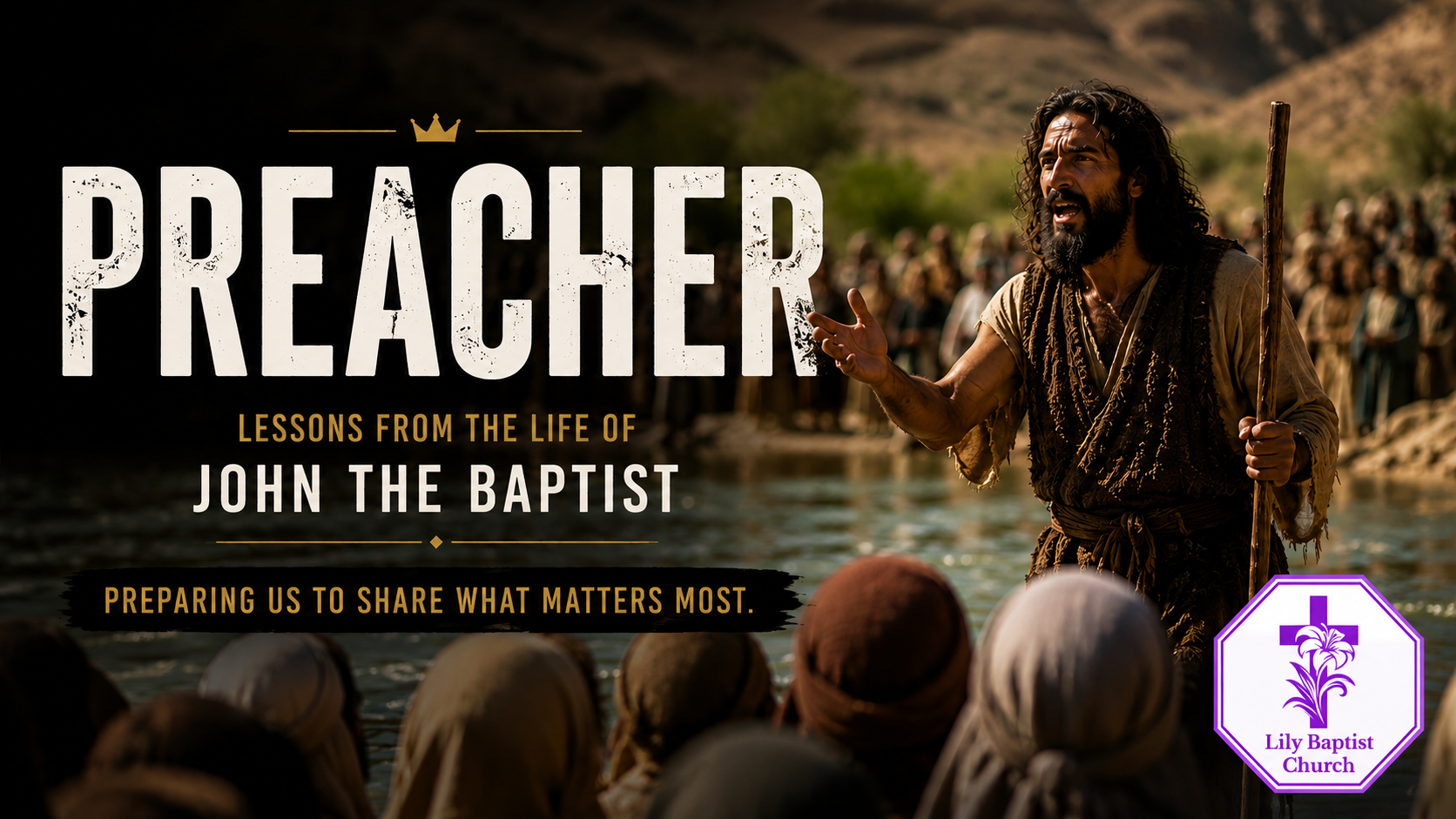
Preacher — Part 3: Remember Your Testimony
Scripture: Luke 7:18–23 (NKJV)
Series: Preacher — Part 3 of 3
Lily Baptist Church | Tarrant, Alabama
2026 Vision: All Things New
2 Corinthians 5:17 (NKJV)
“Therefore, if anyone is in Christ, he is a new creation; old things have passed away; behold, all things have become new.”
Declaration: “I’m becoming who God wants me to be.”
As we pursue All Things New, we continue to challenge ourselves to:
Believe — Trust God, trust the process, hear God clearly, and respond in worship.
Belong — Honor God, honor yourself, honor others, and create an environment for healing.
Become — Represent God everywhere, be the light in the room, and live as an ambassador for Christ.
Series Review
Throughout the Preacher series, we have asked three important questions:
What does it mean to preach?
What does it take to preach?
Who has been called to preach?
John the Baptist has served as our example.
In Part 1, we learned that we are all preachers, whether we realize it or not. We may not all stand behind a pulpit, but every believer has been called to represent Christ through our words, actions, and witness.
In Part 2, we discovered four messages that we can preach with our words and actions: salvation, kindness, repentance, and peace.
Now, in Part 3, we learn how to strengthen our faith and our message through something every believer possesses:
Our testimony.
Main Scripture: Luke 7:18–23
Luke 7:18–23 (NKJV)
“Then the disciples of John reported to him concerning all these things. And John, calling two of his disciples to him, sent them to Jesus, saying, ‘Are You the Coming One, or do we look for another?’ When the men had come to Him, they said, ‘John the Baptist has sent us to You, saying, “Are You the Coming One, or do we look for another?”’ And that very hour He cured many of infirmities, afflictions, and evil spirits; and to many blind He gave sight. Jesus answered and said to them, ‘Go and tell John the things you have seen and heard: that the blind see, the lame walk, the lepers are cleansed, the deaf hear, the dead are raised, the poor have the gospel preached to them. And blessed is he who is not offended because of Me.’”
John the Baptist finds himself in a difficult situation. This is the same John who prepared the way for Jesus, baptized Jesus, heard the voice of God, and witnessed the Holy Spirit descend upon Jesus.
Yet now John needs reassurance.
He sends his disciples to Jesus with a question:
“Are You the Coming One, or do we look for another?”
Sometimes doubts creep in.
Sometimes circumstances cause us to question what we thought we knew.
Sometimes we wonder whether we heard God correctly.
Sometimes we need reassurance that we are walking in the right direction.
Sometimes we simply need God to recharge our faith.
John’s experience reminds us that moments of uncertainty do not erase everything God has already done. Jesus responds by directing John’s attention back to the evidence of God’s work.
There are three things we need to remember as we strengthen our faith and share it with others.
1. Remember What You’ve Seen
Luke 7:20–22 (NKJV)
“When the men had come to Him, they said, ‘John the Baptist has sent us to You, saying, “Are You the Coming One, or do we look for another?”’ And that very hour He cured many of infirmities, afflictions, and evil spirits; and to many blind He gave sight. Jesus answered and said to them, ‘Go and tell John the things you have seen and heard: that the blind see, the lame walk, the lepers are cleansed, the deaf hear, the dead are raised, the poor have the gospel preached to them.’”
John’s disciples came looking for an answer.
Jesus gave them something to see.
While they were there, Jesus cured people suffering from infirmities and afflictions. He cast out evil spirits. He gave sight to the blind.
Then He told them:
Go tell John what you have seen.
Jesus pointed them toward the evidence.
What Have You Seen?
We should ask ourselves the same question:
What have you seen God do?
What prayers have you seen answered?
What doors have you seen God open?
What situations have you seen God turn around?
What families have you seen restored?
What people have you seen delivered?
What provision have you experienced when you didn’t know how your needs would be met?
What have you seen that caused you to say, “Only God could have done that”?
Sometimes our problem isn’t that God hasn’t done anything.
We have forgotten what He has done.
We become so focused on the difficulty in front of us that we forget the victories behind us.
Our memories can become part of our testimony.
Remember the Works
Jesus said:
John 10:37–38 (NKJV)
“If I do not do the works of My Father, do not believe Me; but if I do, though you do not believe Me, believe the works, that you may know and believe that the Father is in Me, and I in Him.”
Remember the works.
Remember when you didn’t have enough, but God provided.
Remember when you were trapped in what appeared to be a hopeless situation, but God made a way.
Remember when danger was close, but God protected you.
Remember when the door didn’t exist until God opened it.
Remember when somebody appeared to be at the end of the road, but God gave them another opportunity.
Remember What We Have Seen Together
Sometimes our testimony comes from what God has done personally. Other times our faith is strengthened by what we have witnessed God do for someone else.
We have seen people survive serious illnesses.
We have seen relationships restored.
We have seen people change.
We have seen prayers answered.
We have seen people come back stronger after nearly losing everything.
We have seen children grow and develop.
We have seen churches work together for God’s glory.
We have seen God work through His people to impact communities.
So ask yourself again:
What have you seen God do in our church?
What have you seen God do in your life?
What have you seen God do for somebody else?
Jesus told John’s disciples to go tell what they had seen.
The same principle applies to us.
You have to remember it before you can tell it.
Questions for Reflection
- What are three things you have personally seen God do that strengthened your faith?
- What answered prayer have you forgotten because a new problem has taken your attention?
- When has God provided for you when you could not see where the provision would come from?
- What have you witnessed God do in someone else’s life that encouraged you?
- What have you seen God do through Lily Baptist Church that should strengthen your confidence about what He can do next?
- Who needs to hear about something you have seen God do?
This Week’s Challenge: Build a Record of God’s Faithfulness
Write down five things you have seen God do.
They do not all have to be dramatic miracles. Remember answered prayers, unexpected provision, restored relationships, protection, opportunities, spiritual growth, and moments when God gave you strength to endure.
Then choose one of those experiences and tell somebody about it.
Your testimony does not need to be complicated.
Simply say:
“Let me tell you what I’ve seen God do.”
2. Remember What You’ve Heard
Luke 7:20–22 (NKJV)
“When the men had come to Him, they said, ‘John the Baptist has sent us to You, saying, “Are You the Coming One, or do we look for another?”’ And that very hour He cured many of infirmities, afflictions, and evil spirits; and to many blind He gave sight. Jesus answered and said to them, ‘Go and tell John the things you have seen and heard: that the blind see, the lame walk, the lepers are cleansed, the deaf hear, the dead are raised, the poor have the gospel preached to them.’”
Jesus didn’t only tell John’s disciples to report what they had seen.
He told them to report what they had heard.
Imagine everything they heard that day.
They heard people who had been hurting.
They heard the joy of people who had been healed.
They heard the testimonies of people whose circumstances had changed.
They heard people praising God.
They heard the instructions of Jesus.
And most importantly:
They heard the gospel preached to the poor.
What Have You Heard?
We hear plenty of negative and discouraging things.
We hear about problems.
We hear about tragedies.
We hear about division.
We hear about everything that is wrong with the world.
But sometimes we need to intentionally remember:
What have I heard from God?
Have you heard a testimony that strengthened your faith?
Have you heard about somebody being healed?
Have you heard about someone who needed employment and received an opportunity to provide for their family?
Have you heard about believers faithfully supporting one another?
Have you heard an encouraging word in the middle of darkness?
Have you heard a sermon that lifted your spirit?
Have you heard the Lord speak peace to your soul through His Word?
Remember What God Has Been Saying
God’s Word continually reminds us of who He is and who He is calling us to become.
Perhaps you have heard God challenging you to grow.
You have heard God calling you to greater devotion.
You have heard God challenging you to influence others for His kingdom.
You have heard about the promises of God.
You have heard sermons.
You have participated in Bible studies.
You have heard prayers.
You have heard worship.
You have heard testimonies.
You have heard stories of trials, tragedies, triumphs, and victories.
Don’t allow all the negative voices around you to become louder than everything God has been saying.
John needed reassurance, and Jesus told the disciples:
“Go tell John what you’ve heard.”
Sometimes someone else’s testimony is exactly what we need to hear to strengthen our faith.
And sometimes your testimony is exactly what somebody else needs to hear.
Questions for Reflection
- What testimony have you heard recently that strengthened your faith?
- What has God been saying to you through sermons, Bible study, prayer, or Scripture?
- Which voices receive most of your attention—the voices of fear and discouragement or the voices that remind you of God’s faithfulness?
- Can you remember a time when somebody else’s testimony helped you through a difficult season?
- What message has God repeatedly placed before you that you may need to take more seriously?
- What have you heard God doing through Lily Baptist Church and other believers that gives you hope?
This Week’s Challenge: Listen for the Good News
For one week, intentionally pay attention to testimonies of God’s goodness.
When someone tells you how God has blessed, sustained, delivered, provided for, or strengthened them, don’t rush past it. Remember it.
Write down at least three testimonies you hear.
Then encourage someone else by sharing one of them appropriately.
Also spend intentional time in Scripture asking:
“Lord, what do You want me to hear from You today?”
We spend enough time listening to bad news.
Make room to hear the good news.
3. Remember the Blessing of Faith
Luke 7:23 (NKJV)
“And blessed is he who is not offended because of Me.”
This verse can easily be misunderstood.
Jesus was not simply condemning John because he asked a question. Jesus was encouraging John to continue trusting Him.
The idea behind being “offended” here is stumbling.
Jesus is essentially saying:
Blessed is the person who does not stumble because of Me.
Following Jesus requires faith, and faith will sometimes take us into places that feel unfamiliar, uncomfortable, or even unnatural.
Jesus Has Always Challenged Human Expectations
1 Corinthians 1:20–25 (NKJV)
“Where is the wise? Where is the scribe? Where is the disputer of this age? Has not God made foolish the wisdom of this world? For since, in the wisdom of God, the world through wisdom did not know God, it pleased God through the foolishness of the message preached to save those who believe. For Jews request a sign, and Greeks seek after wisdom; but we preach Christ crucified, to the Jews a stumbling block and to the Greeks foolishness, but to those who are called, both Jews and Greeks, Christ the power of God and the wisdom of God. Because the foolishness of God is wiser than men, and the weakness of God is stronger than men.”
Jesus did not always fit people’s expectations.
For many Jews, following Him required moving beyond familiar religious expectations. They had to welcome people they might previously have excluded. They had to submit to Christ’s Lordship. They had to depend upon grace and faith rather than trusting their own ability to keep the law.
To the Greeks, the message of a crucified Savior appeared foolish.
Following Jesus can still feel uncomfortable today.
Sometimes faith asks us to move before we feel ready.
Sometimes obedience requires us to do something we have never done.
Sometimes God calls us beyond what feels natural.
Sometimes Faith Feels Like Using Your Off Hand
Imagine doing something familiar with your nondominant hand.
Something that normally feels natural suddenly feels awkward.
You know what you want to do, but you don’t feel as confident doing it.
That’s how following God can sometimes feel.
God may call you to do something unfamiliar, and immediately you feel insecure or inadequate.
You try.
It doesn’t go perfectly.
You stumble.
But stumbling doesn’t mean God is finished with you.
We’ve All Stumbled
Maybe God called you to change something in your life.
You tried.
You failed.
You stumbled.
Maybe God gave you an opportunity to speak up for what was right, but you became nervous and remained silent.
You stumbled.
Maybe God encouraged you to share your faith, but you became afraid of what someone might think about you.
You stumbled.
Maybe God prompted you to give generously, but fear caused you to hold back.
You stumbled.
Maybe God prompted you to worship freely, but insecurity stopped you.
You stumbled.
We’ve all stumbled.
None of us walks with God perfectly.
The important thing is that we don’t allow a stumble to become the end of our journey.
Get back up.
Keep believing.
Keep growing.
Keep serving.
Keep preaching.
God Can Use You Where You Are
1 Corinthians 1:26–31 (NKJV)
“For you see your calling, brethren, that not many wise according to the flesh, not many mighty, not many noble, are called. But God has chosen the foolish things of the world to put to shame the wise, and God has chosen the weak things of the world to put to shame the things which are mighty; and the base things of the world and the things which are despised God has chosen, and the things which are not, to bring to nothing the things that are, that no flesh should glory in His presence. But of Him you are in Christ Jesus, who became for us wisdom from God—and righteousness and sanctification and redemption—that, as it is written, ‘He who glories, let him glory in the LORD.’”
God has never limited Himself to using people who appear powerful, impressive, accomplished, or completely prepared.
God uses ordinary people.
God uses weak people.
God uses people who are still growing.
God uses people who occasionally stumble.
That means you don’t have to wait until some future version of yourself appears before you allow God to use you.
God can use the version of you that exists today to do good today.
The faith you have today can be exercised today.
The joy you have today can encourage somebody today.
The knowledge you have about Jesus can help somebody today.
The prayers you know how to pray can be prayed today.
The testimony you already have can be shared today.
Don’t allow feelings of inadequacy to cause you to stumble over the opportunity God has placed before you.
Questions for Reflection
- What part of following Jesus currently feels uncomfortable or unfamiliar to you?
- Have you confused stumbling with failure? How might God be asking you to get back up and try again?
- What opportunity have you avoided because you did not believe you were spiritually prepared enough?
- How does 1 Corinthians 1:26–31 challenge the idea that God only uses exceptionally talented or accomplished people?
- Where is God asking you to trust Him even though you don’t completely understand what He is doing?
- What could God accomplish through you today if you stopped waiting to become a “better” version of yourself first?
- How can remembering what you’ve seen and heard strengthen you when your faith begins to stumble?
This Week’s Challenge: Use the Faith You Have
Identify one thing you believe God has been prompting you to do but you have hesitated because you felt inadequate, afraid, or unprepared.
Take one step toward it this week.
Make the phone call.
Have the conversation.
Pray the prayer.
Give the gift.
Offer the apology.
Extend the invitation.
Share your testimony.
Serve where help is needed.
Encourage the person God placed on your heart.
You do not have to know everything before God can use you.
Use the faith you have today to obey God today.
And if you stumble?
Get up and keep going.
Bringing the Message Together
Jesus gave John’s disciples a simple assignment:
Tell John what you’ve seen.
Tell John what you’ve heard.
Remind John not to stumble in his faith.
That assignment gives us a powerful picture of testimony.
When doubts come, remember what you’ve seen.
When discouragement becomes loud, remember what you’ve heard.
When following Jesus becomes difficult, remember the blessing of faith.
Your testimony is more powerful than you may realize.
You don’t have to know every verse in the Bible to tell somebody what God has done for you.
You don’t need a theological degree to tell somebody what you’ve seen.
You don’t need a pulpit to tell somebody what you’ve heard.
You don’t need a title to encourage somebody to keep believing.
You simply need to remember.
And then you need to tell it.
The Preacher Series: Our Final Challenge
Over these three messages, John the Baptist has taught us what it means to be a preacher beyond the pulpit.
Part 1 taught us who preaches:
Every believer has been called to represent Christ as a reconciler, ambassador, witness, and disciple-maker.
Part 2 taught us what we preach:
We proclaim salvation, kindness, repentance, and peace through both our words and our actions.
Part 3 teaches us how our testimony strengthens our preaching:
We remember what we have seen, remember what we have heard, and continue walking by faith.
You have something to preach.
Your life is preaching.
Your kindness is preaching.
Your service is preaching.
Your faith is preaching.
And your testimony is preaching.
So this week, ask yourself one final question:
“What is my life preaching about Jesus?”
Declaration:
“I’m a reconciler!”
“I’m an ambassador!”
“I’m a preacher!”
And through Christ:
“I’m becoming who God wants me to be.”
Invitation to New Life
The greatest testimony we can share is the good news of Jesus Christ.
God created you and loves you. Sin has separated humanity from God, but God’s love is greater than our sin. Because of His love, God sent His Son Jesus Christ to pay the penalty for our sins.
Romans 10:9 (NKJV)
“that if you confess with your mouth the Lord Jesus and believe in your heart that God has raised Him from the dead, you will be saved.”
Jesus died for our sins and rose from the dead. Through faith in Him, we can receive forgiveness, reconciliation with God, and eternal life.
If you are ready to place your faith in Jesus Christ, you can pray:
“God, thank You for creating me and loving me. I realize I have sinned in my life and I’ve been separated from You. I ask You to forgive me for my sins. I believe You sent Your Son Jesus to die and pay the penalty for my sins. I believe He rose from the dead according to the Bible. I confess Jesus as Lord of my life and Savior of my soul. I ask that You send Your Holy Spirit into my heart. In Jesus’ name, Amen.”
If you’ve prayed this prayer, don’t keep it to yourself. Let us know. Visit the Become a Member page on the Lily Baptist Church website and allow us to help you take the next steps in your walk with Christ.