
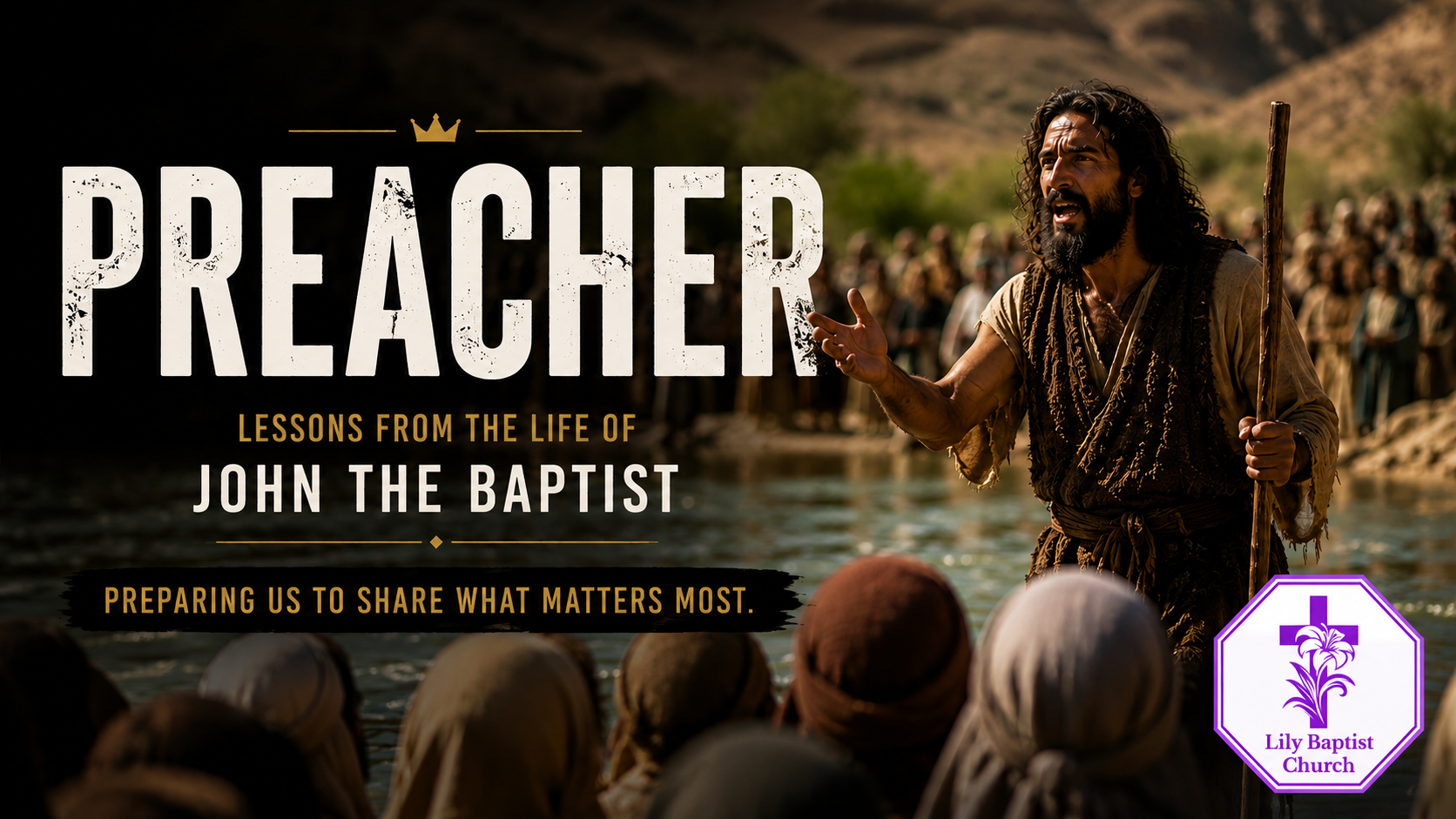
Preacher — Part 2: A Message the World Needs
Scripture: Luke 3:7–14 (NKJV)
Series: Preacher — Part 2 of 3
Lily Baptist Church | Tarrant, Alabama
2026 Vision: All Things New
2 Corinthians 5:17 (NKJV)
“Therefore, if anyone is in Christ, he is a new creation; old things have passed away; behold, all things have become new.”
Declaration: “I’m becoming who God wants me to be.”
Our challenge this year is to Believe, Belong, and Become:
Believe — Trust God, trust the process, hear God clearly, and respond in worship.
Belong — Honor God, honor yourself, honor others, and help create an environment for healing.
Become — Represent God everywhere, be the light in the room, and live as an ambassador for Christ.
Series Review
What does it mean to preach? What does it take to preach? And who has been called to preach?
Throughout this series, we are learning from the life and ministry of John the Baptist. In Part 1, we discovered that while God calls some believers to vocational preaching ministry, every believer has been called to proclaim the good news of Jesus Christ through our words, actions, relationships, and witness.
We are reconcilers.
We are ambassadors.
We are witnesses.
In that sense, we are all preachers.
Part 2 turns our attention from who is called to preach to what we have been called to preach.
Main Scripture: Luke 3:7–14
Luke 3:7–14 (NKJV)
“Then he said to the multitudes that came out to be baptized by him, ‘Brood of vipers! Who warned you to flee from the wrath to come? Therefore bear fruits worthy of repentance, and do not begin to say to yourselves, “We have Abraham as our father.” For I say to you that God is able to raise up children to Abraham from these stones. And even now the ax is laid to the root of the trees. Therefore every tree which does not bear good fruit is cut down and thrown into the fire.’So the people asked him, saying, ‘What shall we do then?’
He answered and said to them, ‘He who has two tunics, let him give to him who has none; and he who has food, let him do likewise.’
Then tax collectors also came to be baptized, and said to him, ‘Teacher, what shall we do?’
And he said to them, ‘Collect no more than what is appointed for you.’
Likewise the soldiers asked him, saying, ‘And what shall we do?’
So he said to them, ‘Do not intimidate anyone or accuse falsely, and be content with your wages.’”
John’s preaching gives us four messages that we need as we seek to reach our families, neighborhoods, workplaces, and community: the message of salvation, the message of kindness, the message of repentance, and the message of peace.
1. The Message of Salvation
Luke 3:7–9 (NKJV)
“Then he said to the multitudes that came out to be baptized by him, ‘Brood of vipers! Who warned you to flee from the wrath to come? Therefore bear fruits worthy of repentance, and do not begin to say to yourselves, “We have Abraham as our father.” For I say to you that God is able to raise up children to Abraham from these stones. And even now the ax is laid to the root of the trees. Therefore every tree which does not bear good fruit is cut down and thrown into the fire.’”
John begins with a difficult message. He warns the people about judgment, calls them to repentance, and challenges their assumption that their ancestry could make them right with God.
Why begin there?
Because the good news is so good because the bad news is so bad.
The bad news is that God has a standard of holiness and righteousness that humanity has failed to meet. Sin separates us from God, and sin carries consequences.
John does not preach judgment merely to frighten people. He wants them to understand their need for salvation.
Knowing the Danger Should Motivate Us
2 Corinthians 5:10–11 (NKJV)
“For we must all appear before the judgment seat of Christ, that each one may receive the things done in the body, according to what he has done, whether good or bad. Knowing, therefore, the terror of the Lord, we persuade men; but we are well known to God, and I also trust are well known in your consciences.”
Paul says that because we understand the seriousness of standing before God, “we persuade men.”
We don’t share Jesus simply because we want more people in church.
We share Jesus because people need salvation.
And that brings us to the good news.
God sent His Son, Jesus Christ, to pay the penalty for our sins, forgive us, and deliver us from the power of sin. Through faith in Christ, we can move from eternal death to eternal life.
That is salvation.
That is reconciliation.
That is our primary message.
Declaration: “I’m a reconciler!”
Salvation Changes Our Entire Life
The sermon describes salvation in three dimensions:
Past — Justification: Freedom from the penalty of sin. We accept Jesus and are declared righteous through faith.
Present — Sanctification: Freedom from the power of sin. The Holy Spirit continually transforms us as we learn to live for Jesus.
Future — Glorification: Freedom from the presence of sin. We look forward to eternity with Christ.
Christianity, therefore, is more than self-help or temporary improvement. The gospel is about salvation through Jesus Christ.
Questions for Reflection
- Why does understanding the seriousness of sin help us understand the greatness of salvation?
- When you talk about Christianity with others, do you focus more on blessings and life improvement or on salvation through Jesus Christ?
- How has Jesus delivered you from the penalty and power of sin?
- Who has God placed in your life who needs to hear the message of salvation?
- Are you concerned enough about people who do not know Christ to lovingly share the gospel with them?
This Week’s Challenge
Write down the names of three people who need Jesus. Pray for them every day this week. Ask God to open an opportunity for you to share why Jesus matters to you and what He has done in your life.
Don’t begin by trying to change their lifestyle. Begin by pointing them toward the One who can change their heart.
2. The Message of Kindness
Luke 3:10–11 (NKJV)
“So the people asked him, saying, ‘What shall we do then?’ He answered and said to them, ‘He who has two tunics, let him give to him who has none; and he who has food, let him do likewise.’”
After hearing John’s message, the people asked a practical question:
“What shall we do then?”
John’s answer was remarkably simple: share what you have with somebody who doesn’t have it.
Repentance should produce a visible difference in the way we treat people.
Jesus summarized the Christian life in much the same way.
Matthew 22:36–40 (NKJV)
“‘Teacher, which is the great commandment in the law?’ Jesus said to him, ‘“You shall love the LORD your God with all your heart, with all your soul, and with all your mind.” This is the first and great commandment. And the second is like it: “You shall love your neighbor as yourself.” On these two commandments hang all the Law and the Prophets.’”
We receive God’s love, love God in return, and then demonstrate His love by loving our neighbors.
Let People Experience the Love We Preach
At Lily Baptist Church, we want to create a place where people can Believe, Belong, and Become.
But people will not know that our faith is real simply because we tell them it is.
They need to see it.
They need to experience it.
Our preaching becomes visible through:
Kindness. Generosity. Compassion. Acceptance. Service.
People need to experience the love we talk about.
The message of kindness is preached whenever someone experiences the compassion of Christ through us.
Declaration: “I’m an ambassador!”
As ambassadors, we represent another kingdom. That means Christians should become examples of what kindness, generosity, compassion, and grace look like.
Our lives should make the reality of God visible.
Questions for Reflection
- If someone knew nothing about Christianity except what they saw in your life, what would they believe about God?
- When was the last time your faith caused you to give something to someone who could not repay you?
- Is there anyone you find difficult to treat with kindness? Why?
- Does our church community make newcomers and hurting people feel that they genuinely belong?
- What is one need in Tarrant or the surrounding community that Christians could address through practical kindness?
This Week’s Challenge
Preach without words at least once this week.
Give something.
Feed someone.
Encourage someone.
Help someone.
Welcome someone.
Do something in the name of Jesus that allows another person to experience the love of God rather than merely hear about it.
3. The Message of Repentance
Luke 3:12–13 (NKJV)
“Then tax collectors also came to be baptized, and said to him, ‘Teacher, what shall we do?’ And he said to them, ‘Collect no more than what is appointed for you.’”
Tax collectors came to John with the same question: “What shall we do?”
Tax collectors had a reputation for exploiting people. They could use the authority of Rome to collect more than was required and keep the excess for themselves.
John’s response was direct:
Stop doing what you know is wrong.
Stop doing what displeases God.
Change your ways.
Bring your life into alignment with God’s will.
That is repentance.
Repentance Is More Than Feeling Bad
2 Corinthians 7:9–10 (NKJV)
“Now I rejoice, not that you were made sorry, but that your sorrow led to repentance. For you were made sorry in a godly manner, that you might suffer loss from us in nothing. For godly sorrow produces repentance leading to salvation, not to be regretted; but the sorrow of the world produces death.”
There is a difference between regret and repentance.
Regret says, “I feel bad about what happened.”
Repentance says, “With God’s help, I’m changing direction.”
Godly sorrow moves us toward transformation.
We Cannot Force Repentance
One of the most important principles in this sermon is that we cannot make another person repent.
We cannot pressure someone into genuine spiritual transformation.
Our responsibility is to tell the truth, reveal God’s will, teach God’s Word, demonstrate God’s ways, and help people draw closer to Him.
Then we trust the Holy Spirit to work in their hearts.
As people know God more deeply, their desire to please Him should grow. Through the power of the Holy Spirit, their lives, attitudes, conversations, and actions can increasingly look like Jesus.
This is another reason we are reconcilers: we help people move closer to God.
Declaration: “I’m a reconciler!”
Questions for Reflection
- Is there an area of your life where God has already shown you that change is necessary?
- Are you experiencing repentance or merely regret?
- Why is it dangerous to try to force spiritual change in another person?
- Have you ever expected someone to behave like a mature Christian before they had developed a relationship with Christ?
- What would becoming more like Jesus look like in your attitudes, conversations, relationships, and habits?
This Week’s Challenge
Ask God one honest question in prayer:
“Lord, what needs to change in me?”
Don’t begin with someone else’s faults.
Begin with yourself.
When God reveals something that is out of alignment with His will, identify one concrete action you can take to begin changing direction. Ask the Holy Spirit for the power to follow through.
4. The Message of Peace
Luke 3:14 (NKJV)
“Likewise the soldiers asked him, saying, ‘And what shall we do?’ So he said to them, ‘Do not intimidate anyone or accuse falsely, and be content with your wages.’”
The final group to approach John was a group of soldiers. These men represented the authority of Rome. They had power, position, and the ability to exercise authority over others.
When they asked John, “What shall we do?” his answer addressed the way they used their power:
“Do not intimidate anyone or accuse falsely, and be content with your wages.”
In simple terms, John was telling them:
Don’t abuse your power.
Power can be dangerous when it is separated from humility. It can cause us to think more highly of ourselves than we should. People who possess power and influence always face a choice:
We can empower or overpower.
We can build up or tear down.
John challenged the soldiers to use their authority differently because their relationship with God should change the way they treated other people.
You Have More Influence Than You Think
You may read this passage and think, “I’m not a soldier. I don’t have that kind of authority. How does this apply to me?”
As believers, we have spiritual influence.
When we make disciples, we accept responsibility for helping other people grow spiritually. New believers may look to mature Christians to help them understand what following Jesus looks like.
We teach them about God.
We help them learn God’s Word.
We teach them to pray.
We lead them in worship.
We help facilitate their transformation.
We help them understand how the church operates.
Most importantly, we model what it looks like to live as believers.
Just as Jesus led His disciples, we have opportunities to lead and influence other disciples.
That means we need to ask ourselves:
What am I doing with the spiritual influence God has given me?
Don’t Let Your Position Go to Your Head
Spiritual influence can become dangerous when we forget that everything we have is because of God’s grace.
Even within the church, things that should be blessings can become sources of pride.
Membership status can become a badge of honor that causes longtime members to look down on newcomers.
Righteousness can become a measuring stick we use to judge everyone else.
Social standing can divide a congregation into groups.
Economic standing can create a hierarchy based on money instead of godliness.
Education can become a reason to consider ourselves intellectually superior to others.
Family status can become a way of judging single parents, unmarried people, divorced people, or families whose circumstances are different from our own.
Church accomplishments can become ways of proving our importance.
When these things become sources of pride, we can begin believing that we are better than other people.
But none of our church accomplishments mean anything to someone who doesn’t know Jesus.
Our titles do not impress people who are hurting.
Our positions cannot heal someone who is broken.
Our accomplishments cannot save someone who is lost.
And our religious activity cannot substitute for a genuine relationship with Jesus Christ.
A Relationship With Jesus Matters More Than Religious Accomplishments
Matthew 7:21–23 (NKJV)
“Not everyone who says to Me, ‘Lord, Lord,’ shall enter the kingdom of heaven, but he who does the will of My Father in heaven. Many will say to Me in that day, ‘Lord, Lord, have we not prophesied in Your name, cast out demons in Your name, and done many wonders in Your name?’ And then I will declare to them, ‘I never knew you; depart from Me, you who practice lawlessness
Questions for Reflection
- How are you using the influence God has given you? Are you using your position, experience, knowledge, and relationships to empower others or to overpower them?
- Has anything in your Christian life become a source of pride? Consider your years of church membership, ministry position, biblical knowledge, education, accomplishments, family background, or social standing. Has any of it caused you to look down on someone else?
- How do people who are new to the church experience you? Do your words and actions communicate, “There is a place for you here,” or do they make people feel like outsiders?
- Who are the people you may have overlooked because their life does not look like yours? How could you intentionally demonstrate the grace and welcome of Christ to them?
- When conflict arises, are you usually a peacemaker or an instigator? Do your words calm difficult situations or make them worse?
- Are you more concerned with protecting your position or helping another person grow? How could you use what you have learned through the years to strengthen someone who is newer in the faith?
- What would change if you truly remembered that “the ground is level at the cross”? How should remembering your own need for grace affect the way you treat someone who is struggling?
- Who is God calling you to bring closer to Christ? What could you do this week to help that person feel seen, valued, welcomed, and loved?
This Week’s Challenge: Preach Peace
John challenged the soldiers to stop using their power to intimidate and begin using it in a godly way. This week, examine the influence God has entrusted to you and intentionally use it to build someone else up.
Choose at least one person—especially someone who is new, overlooked, hurting, younger in the faith, or different from you—and intentionally encourage them.
Use your experience to guide instead of criticize.
Use your position to open a door instead of guarding one.
Use your knowledge to teach instead of impress.
Use your words to bring peace instead of conflict.
Use your influence to make someone feel important instead of proving your own importance.
Then ask yourself at the end of the week:
“Did my life make it easier for someone to come closer to Jesus?”
Remember, the message of peace covers, protects, delivers, breaks down walls, welcomes others in, and brings unity and stability.
Declaration: “I’m a reconciler! I’m an ambassador! I’m a preacher!”
Prayer Challenge:
Each morning this week, pray: “Lord, show me how You can use my life today to bring someone closer to Christ. Help me use my influence with humility, represent Your kingdom with grace, and preach Your peace through the way I treat others. In Jesus’ name, Amen.”